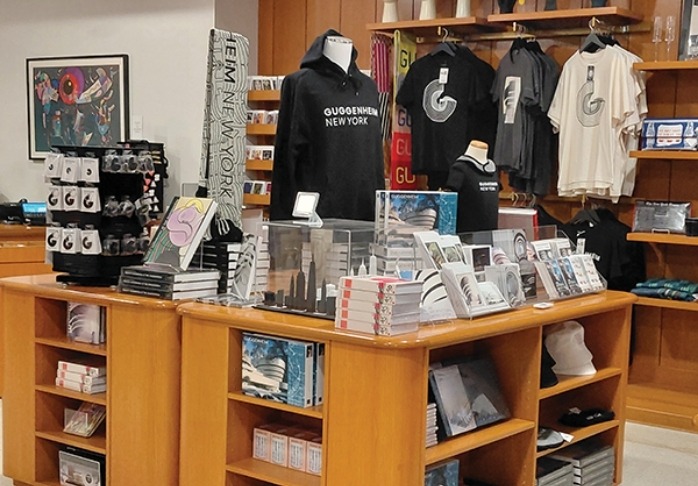
A Rotating Experience: The Guggenheim Store
The Solomon R. Guggenheim Foundation was founded in 1937, and the Solomon R. Guggenheim Museum, designed by Frank Lloyd Wright, opened on Fifth Avenue in New York City in 1959. Initially controversial because of its radical architectural design, the museum today is considered one of the most important and beloved museum buildings in the world.
Elizabeth Vaccari, store director at the Guggenheim, said one of the museum’s most special qualities is how deeply visitors connect with the building itself.
“It is truly an incredible work of art in its own right,” she said. “The museum boasts a world-famous permanent collection while continuously presenting exciting rotating exhibitions, so there is always something new to experience.”
CONNECTING WITH ART
The Guggenheim is not only one of the world’s most celebrated museums of modern and contemporary art, but also a globally recognized architectural landmark and UNESCO World Heritage Site, making it one of New York City’s top tourist attractions. Vaccari said visitors come not only to experience the exhibitions and collection, but also to experience the building itself.
“The rotunda, skylight and spiral design create an immersive environment unlike any other museum,” she said. “It’s a place that leaves a lasting impression.”
The Guggenheim is also a constellation of museums and cultural spaces around the world, including the Guggenheim Museum Bilbao, the Peggy Guggenheim Collection and the forthcoming Guggenheim Abu Dhabi.
The museum’s mission is to promote understanding and appreciation of modern and contemporary art through its permanent collection, rotating exhibitions and educational and cultural programming.
“The museum creates opportunities for visitors to connect deeply with art, architecture and ideas in a truly immersive environment,” Vacari said.
AN EVER-CHANGING EXPERIENCE
The Guggenheim Store aims to extend and enrich the museum experience as a whole. Guests enjoy decompressing in the shop, continuing conversations about the exhibitions and sharing impressions of their visit with the store team, according to Vaccari.
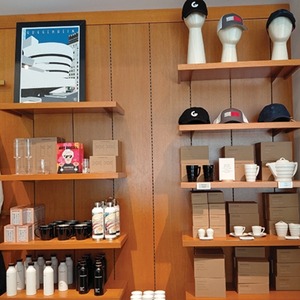
“Our goal is for visitors to enjoy the store as its own creative and inspiring environment while also finding the perfect object to take home: something that reminds them of their experience and deepens their connection to the Guggenheim long after they leave,” she said.
The store offers exhibition merchandise, art books, exhibition catalogues, design objects, jewelry, home décor, architectural souvenirs, stationery, apparel, children’s items and more. Because the Guggenheim regularly presents major rotating exhibitions, the store continually evolves with exhibition-related merchandise reflecting the artists and themes on view.
At the same time, the store’s most consistent top-sellers are products inspired by the building itself.
“That balance between rotating exhibition merchandise and timeless Guggenheim-specific souvenirs creates a shopping experience that feels unique every single time,” she said.
The purchasing team works to find products that align with the museum’s specialized offerings and discerning audience.
“Merchandising at the Guggenheim is highly experiential,” Vaccari said. “We want displays to feel visually engaging and connected to the atmosphere visitors experience throughout the museum. The goal is for the store to feel like a natural continuation of the Guggenheim experience itself. It’s a constant evolution.”
PRODUCTS TO REMEMBER
Visitors are drawn to pieces that feel meaningful and connected to their personal museum experience. While souvenirs remain popular, the team also cited strong interest in standout accessories, apparel and home items.
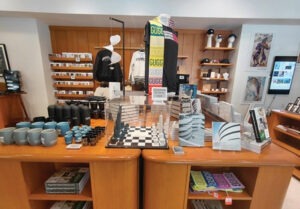
“Customers are really looking for unique pieces; they are looking for items they cannot find anywhere else,” she said. “… For some visitors, that means investing in a larger design object or luxury accessory, while others are searching for smaller keepsakes or affordable collectibles. We work hard to provide, promote and recommend meaningful options across a wide range of price points.”
Exhibition catalogues and publications are consistently among the strongest sellers, especially during major exhibitions.
“It’s always fascinating to watch how each exhibition influences customer interests while also seeing the timeless appeal of our core Guggenheim merchandise remain constant,” she said.
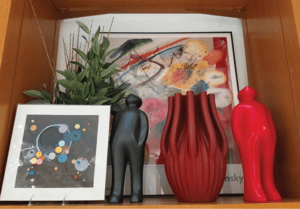
A favorite piece of Vaccari is the “Visitors” sculpture by sculptor Guido Deleu, an abstract figure looking upward. “It perfectly captures the experience of standing beneath the spirals and skylight of Wright’s ‘temple of spirit’ and taking in the awe of the Guggenheim experience,” she said.
The Guggenheim experience is designed to stay with visitors long after they leave — the architecture, exhibitions and atmosphere. The store also becomes an important part of that memory.
“So many guests tell us they have dreamed of visiting the museum for years, and it’s incredibly meaningful for us to help make that experience special,” she said.